

Kirat worship
The Kirat people are nature worshipers who believe that the five elements of nature earth, water, air, fire, and sky—are manifestations of the supreme God, Tagera Ningwaphumang, the first motherly divine power of the universe and the creator of all. Additionally, they believe in the divinity of the soul and the concept of incarnation.
TAGERA-NINGWABHU-MANG
Samjik Mundhum narrates that the Supreme God Tagera Ningwaphumang is a Menni Mang, Mendha Mang, Nise Mang, which means formless, imageless, true supreme divine power—the supreme truth without beginning, end, birth, or death, and omnipresent. This deity is also called “Oth,” meaning bright light, which is a symbol of Kiratism. Tagera Ningwaphumang is the highest form of God, the invisible creator of the universe, recognized as a true and compassionate deity. This reverence is expressed through the recitation of mantras during Kirat religious ceremonies, which encompass all stages of human life, from birth to death, and during the propitiation of other gods and goddesses in various ritual activities
Worship and places of worship
The Kirats, in the time of their ancestors, had no artificially constructed temples and recited the Mundhum orally. They considered natural caves, trees, and mountains as temples and did not worship idols. They regarded air, water, fire, earth, sky, rivers, large stones, and nature itself as gods and offered sacrifices of animals, birds, and blood. However, the Mundhum also describes that, with the development of human civilization, various gods and goddesses were established and worshipped to protect every living creature on Earth, including forests, humans, and animals. This system of worship continues to this day, including deities such as Yuma Sammang, Theba Sammang, Akwanama, Nahen Sammang, Tambhungna Sammang, Manggenna, Nahangma Manggenna, and Muden Sammang etc.
As time passed and with the advent of the modern era, their gurus began building physical, artificial temples and other infrastructures visible to everyone, such as Mujolung and Khejolung, along with statues of the great gurus. Since the time of Mahaguru Muhingum Ongsi Falgunanda Lingden, the oral Mundhum was recorded in writing to preserve it for future generations. He also conveyed religious messages to his followers, urging them to stop killing animals and birds in the name of gods and goddesses during worship. Instead, they were advised to worship all gods and goddesses by offering fruits, flowers, and lighting lamps.
Mahaguru Muhingum Ongsi Phalgunanda Lingden explained, according to the Samjik Mundhum, that the creator has not given us the right to torture or kill animals, birds, or any living creatures. The Mundhum states: “eksa khambek khemma, pokla lunglang khemma, tabu singlang khemma, chavat thungwa khemma fa-ang thokpu kubu, yongghan kussa, thupmen pewa, yasa khirey, leknga, hayonggna ha-ren nawa chait chogung-sing-ang waro,” which means: “I have created animals, birds, fishes, and many living beings to beautify the earth, rivers, oceans, and forests.” And again, the Mundhum says: “Taandi thokpu kubu, yongghan kussa, thupmen pewa, yasa khirey ha yorik mebon-nang tarang tangsang le meghoptusin-niya, eksa khambek, chavat thungwa o mehatun-xin-niya, chaghat chamvanle meyoruxin-niya pha-ang keba, mayu, muya, hamba ha-ren nawa chait chogung thangsing-aang waro,” meaning: “In the future, these creatures—animals, birds, and fishes—may become so numerous that the sky may not cover them, and the earth, rivers, and oceans may not be able to accommodate them, nor provide enough food. Therefore, to control the spread of these animals, birds, and fishes, I have created tigers, bears, eagles, otters, minks, snakes, and others. Also, to protect and save all these creatures, I have created humans as conscious beings.”
Mujolung and Khejolung
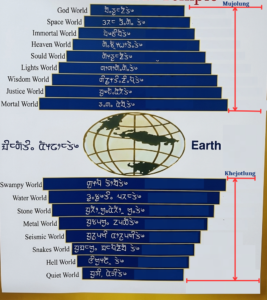
The Kirat cosmology, as narrated in the Samjik Mundhum, describes the spiritual cosmic layers or ethereal planes above the earthly level as divided into nine layers called Mujolung. Similarly, beneath the earth, the spiritual and physical natural structure is divided into nine layers and into nine parts, known as Khejolung.

Mujolung
Mujotlung: The Kirat Manghim (Tshoekhang) Mujotlung (worshipping place) consists of nine steps, including the ground level (mortal world), arranged from top to bottom as follows: (1) Mangyukna Den (2) Tarong Tangsang Den (3)Menchima Den (4)Sangram Pedang Den (5)Samyukna Den (6)Seseba Den (7) Sikumding Ningwa Den (8)Mundhang Khara Den and (9)Yongsong Den, which is the earth. The steps are decorated with butter lamps, flower vessels, and at the top, three butter lamps along with three flower vessels represent the tri-almighty gods Yumamang, Himmang, and Thebamang, as well as the natural elements: earth, sky, water, air, and fire, which the Kirati worship as a shrine.
Before erecting the Mujotlung, all essential and precious items required by human beings—such as gold, diamond, silver, brass, copper, iron (Zung), and rice grain—are placed in a pit dug inside the Mujolung. In front of the Mujolung, towards the east, a “timeless butter lamp” is lit, considered auspicious. It symbolizes enlightenment, prosperity, knowledge, and wisdom. The butter lamp (མར་མེ = Masemi) represents the dedication of one’s merits to all sentient beings for their liberation from darkness.

Khejotlung
Khejotlung is located to the east of Mujotlung Manghim. It consists of a nine-step structure that descends from ground level toward the earth. This site serves as a place of worship where devotees offer divine fire smoke to spirits and local deities. The steps are labeled from top to bottom as follows: (1)Eksading Khambek Den (2) Sumwado Mekwadoma Den (3) Tunggunding Warok Den (4) Mugaplung Kaffa Den (5)Murupli Kherupli Den (6)Mu;oaklung Akwama Den(7) Murotlung Kherotlung Den (8)Helumbat Den and (9) MujiKheji Den.